Monday, November 20, 2017
Someone Else's Shoes
A lot of times as parents we say to our kids; "Put yourself in their shoes." What we are wanting our kids to do is to think about a situation from someone else's perspective. This is a skill that I want all of my kids to be able to do. If we can truly think about issues and situations from someone else's perspective I think it will help us become more compassionate and empathetic people.
During this time of year as we purposefully take time to be thankful, the thing I find myself being most thankful for year after year is my family. My wife, kids, mom, dad, siblings, in-laws, aunts, uncles, cousins, etc. Family has always been a huge part of my life and I really do not know anything different. As I find myself being so grateful for the family I have, I cannot help but think of the children who do not have it as fortunate as I did. There are over 400,000 children in the US in foster care and I find myself asking "What do these kids have to be thankful for?" I serve as the CASA for 28 children in our county and I so badly want each and everyone of these kids to have a home and family that they too can be thankful for.
I love it that National Adoption Month and Thanksgiving share the same month because the more I find myself being thankful for all the blessings I have in my life, the more motivated I am to want those same blessings for the lives of children everywhere.
Monday, November 6, 2017
Adoption Tax Credit
Some of you may know that I (Matt) am a Court Appointed Special Advocate (CASA). As a CASA, part of my job is to speak on behalf of the kids in court. I take in all of the information that I can assess the situation and make recommendations to the court on what I think is in the best interest of the child. When I find myself thinking about my role and responsibility as a CASA, I am reminded of Proverbs 31:8-9:
"Speak up for those who cannot speak for themselves; ensure justice for those being crushed. Yes, speak up for the poor and helpless, and see that they get justice." (NLT)
Today I feel the need to speak up about another issue, the Adoption Tax Credit. The Adoption Tax Credit has been around since 1996 and hundreds of thousands of families have benefited from this tax credit, including myself. Currently the credit is capped at $13,460. This credit is often times the deciding factor on whether families adopt or not. If this credit goes away, I am sure that more families will decide not to adopt because it is simply too costly. There are already over 100,000 children waiting to be adopted in the US alone.
To some, this may simply be about the numbers. It is hard for me to reduce the lives of children down to numbers, but for the sake of the argument, I will. Adoption most certainly saves the government money. Let's just look at the young people who age out of the foster care system. These are children who are not reunified with family and who are never adopted. According to a study done by Jim Casey Youth Opportunities, there are approximately 25,000 youth who age out of foster care every year. On average, every young person who ages out, ends up costing tax payers $300,000 over that persons lifetime. So after doing a little math, that is $7.5 billion for every cohort of youth who age out.
Although the numbers are important, there is no greater argument than this; every child deserves to grow up in a loving, stable, and permanent home. If a $13,460 tax credit will help more families be able to afford an adoption, this is something I must be supportive of. So on behalf of all the children who currently do not have a loving, stable and permanent home, my plea to all the members of the House is this, "Do not repeal the Adoption Tax Credit."
We can all do our part by contacting our representatives and letting them know how we feel about this. You can find out who your representatives are by going here.
Friday, October 27, 2017
Finally!
Many of you know and have read about the Empowered to Connect parent trainings that Stacey and I, and Anthony and Lauren Troyer teach in our area. These trainings are 9 week trainings that meet every week for 2 hours every time.
I have been working at trying to get our training approved by the State of Indiana so that our foster families who participate in our training can count these hours towards their continuing education hours that they need every year to maintain their foster license.
After about a year, I am excited to announce that my persistence (or maybe annoyance) has paid off. Our training was officially approved on October 6th! This will be a huge benefit for those foster families who sign up for our trainings.
You Can Be a Trainer
The next Train the Trainer (TTT) event is going to be held in Chicago on March 8-10, 2018.
If you are interested in being a trainer, please contact me at matt@villagetovillageintl.com and I will send you the application to the TTT in Chicago.
Thursday, September 7, 2017
Don't Reinvent The Wheel
It is an expression we all know and use quite often, and we are going to take this expression to heart. Don't reinvent the wheel.
You may have read our recent post entitled Foster Hope, where we laid out our vision to help support foster families in our county. We have since come across an organization out of Indianapolis who is already doing the very thing we are wanting to do. Not only are they doing what we want to do, but they were willing to train us and share with us everything we need in order to do the same thing in northern Indiana. This amazing organization is called Hands of Hope. Laura and Suzy have been great to work with and their willingness to share with us the resources they have developed is going to save us hours and hours and hours of time.
So with no further ado; we would like to announce our new initiative; Care Communities (formerly known as Foster Hope).
Care Communities Introduction
Nationally, 50% of foster families quit either after their first year or after their first placement, primarily because they did not feel supported. The Care Communities model has been proven to retain up to 95% of those foster parents.
Care Communities are teams of 6-8 people that wrap around a foster family with the purpose of supporting them. Members choose which role they want to play in the care community.
Roles in a Care Community
Family Helper: Serves the family in tangible ways including meals, house cleaning, laundry, errands, yard work,etc.
Child Mentor: This role is more involved with the life of the child. Child Mentors will provide childcare at least twice a month. Childcare is the area where foster parents need the most support and tend to receive the least.
Team Leader: This role allows for organization of the team as well as you getting to be very involved with the foster family. Generally, tasks will require a time investment of less than an hour per week. Responsibilities include a weekly phone call to the foster family, and a weekly email updating the team on needs of the foster family. The team leader can also serve as a family helper or child mentor.
Interim Caregiver: This role provides overnight care for the foster family when needed.
Are You Interested?
If you live in northern Indian and are interested in starting a care community where you live, we would love to help. Please contact Anthony Troyer at anthony.troyer@gmail.com for more information.
You may have read our recent post entitled Foster Hope, where we laid out our vision to help support foster families in our county. We have since come across an organization out of Indianapolis who is already doing the very thing we are wanting to do. Not only are they doing what we want to do, but they were willing to train us and share with us everything we need in order to do the same thing in northern Indiana. This amazing organization is called Hands of Hope. Laura and Suzy have been great to work with and their willingness to share with us the resources they have developed is going to save us hours and hours and hours of time.
So with no further ado; we would like to announce our new initiative; Care Communities (formerly known as Foster Hope).
Care Communities Introduction
Nationally, 50% of foster families quit either after their first year or after their first placement, primarily because they did not feel supported. The Care Communities model has been proven to retain up to 95% of those foster parents.
Care Communities are teams of 6-8 people that wrap around a foster family with the purpose of supporting them. Members choose which role they want to play in the care community.
![]() |
| Sometimes a picture helps |
Family Helper: Serves the family in tangible ways including meals, house cleaning, laundry, errands, yard work,etc.
Child Mentor: This role is more involved with the life of the child. Child Mentors will provide childcare at least twice a month. Childcare is the area where foster parents need the most support and tend to receive the least.
Team Leader: This role allows for organization of the team as well as you getting to be very involved with the foster family. Generally, tasks will require a time investment of less than an hour per week. Responsibilities include a weekly phone call to the foster family, and a weekly email updating the team on needs of the foster family. The team leader can also serve as a family helper or child mentor.
Interim Caregiver: This role provides overnight care for the foster family when needed.
Are You Interested?
If you live in northern Indian and are interested in starting a care community where you live, we would love to help. Please contact Anthony Troyer at anthony.troyer@gmail.com for more information.
Thursday, July 27, 2017
Oasis - The Concept
Oasis is our vision to help support youth aging out of foster care. We are planning on doing this by creating an Intentional Neighboring Community (INC). You can read more about it on our website here.
The Why
The simple answer to the question, "Why would you want to do this?" is: We are failing. This graphic pretty much sums it up.
INC Approach
- Assistance is community driven
- Based off the universal need for caring relationships
- Those facing serious social challenges become assets to the community
- Capacity for ordinary people of all ages to care about and for one another
What Does This Look Like
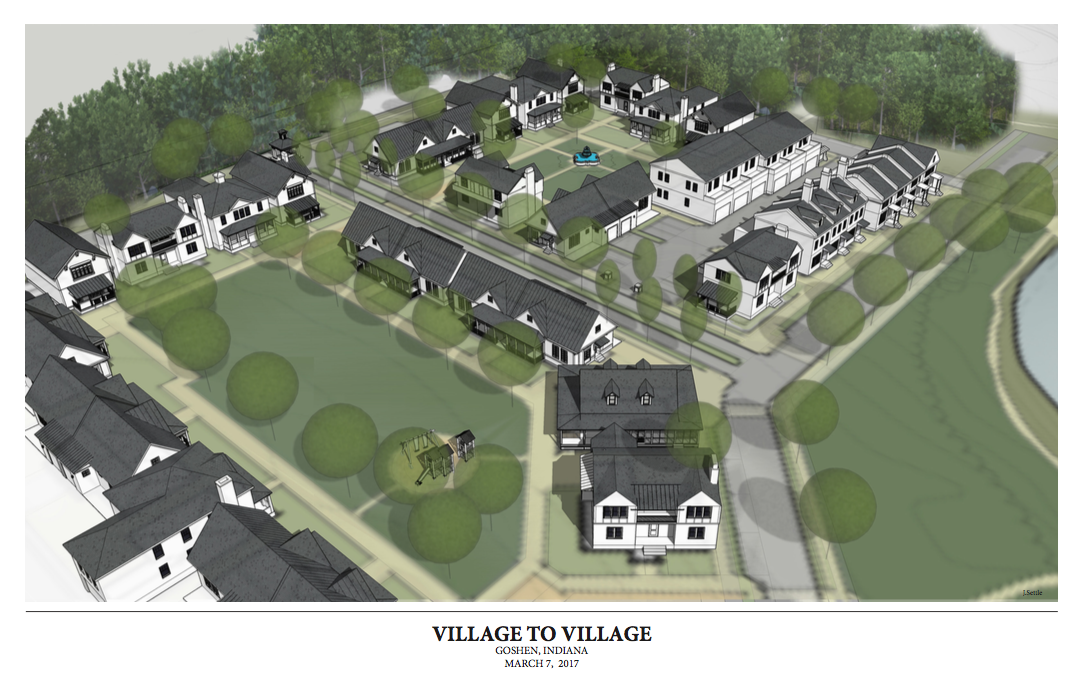
Here is a little idea of what something like this could look like. We are very excited to see what the future holds.
Housing Key
Blue - aging out youth
Yellow - Single family homes
Orange - Senior housing, singles, small families
![]() |
If you are interested in giving to this project, you can do so here.
Foster Hope
A new initiative to bring hope and healing to the children of Elkhart County. Maybe you can do something like this in your area. Here are the details.
The Need
Foster Kids
The Need
Foster Kids
- Elkhart County has 250+ kids in "out of home" foster care
- 1 out of every 5 of those kids are placed in homes outside of Elkhart County
- Over 100 kids do not have Court Appointed Special Advocates (CASA's) to advocate for their needs in court
- There are over 2,200 children in the state of IN waiting to be adopted. 50% of those are under the age of 8
Foster/Adoptive Parents
- About 50% of foster parents quit within a year of their first placement
- Many attribute it to a lack of support from their family, friends, and caseworkers, as well as a lack of preparation for the erratic behaviors of children from hard places
The Misunderstanding
Entering into foster care without being properly prepared can be very damaging to both the foster family and to the foster child/ren. If the placement has to be disrupted and the children placed into a different home the child/ren will only experience more trauma. The need is too great to be handled by isolated individual families assisted by the government. It needs be a function of the church with organized support groups to assist foster and adoptive parents.
The Proposal
Our desire is to function as a liaison between the state and local church to communicate needs. We want to partner with local faith communities to help them figure out how to get involved and provide training and resources to help them be successful. Our involvement might include:
- Starting an orphan care ministry
- Expanding an orphan care ministry
- Recruiting "Support Families" to focus on supporting current foster families
- Trainings on how to care for children from hard places
- Connecting with other faith communities to share information on support groups, bible studies, ministry partnerships, etc.
Desired Outcomes
- Empower churches to figure out how they can most effectively care for local orphans
- To have a permanent surplus of foster families and CASA's in Elkhart County
- To see the majority of local faith communities involved in some way. There are roughly the same number of churches in Elkhart County as there are foster kids. We would love to see every congregation play a role in their care.
Subscribe to:
Posts (Atom)